Front Cover
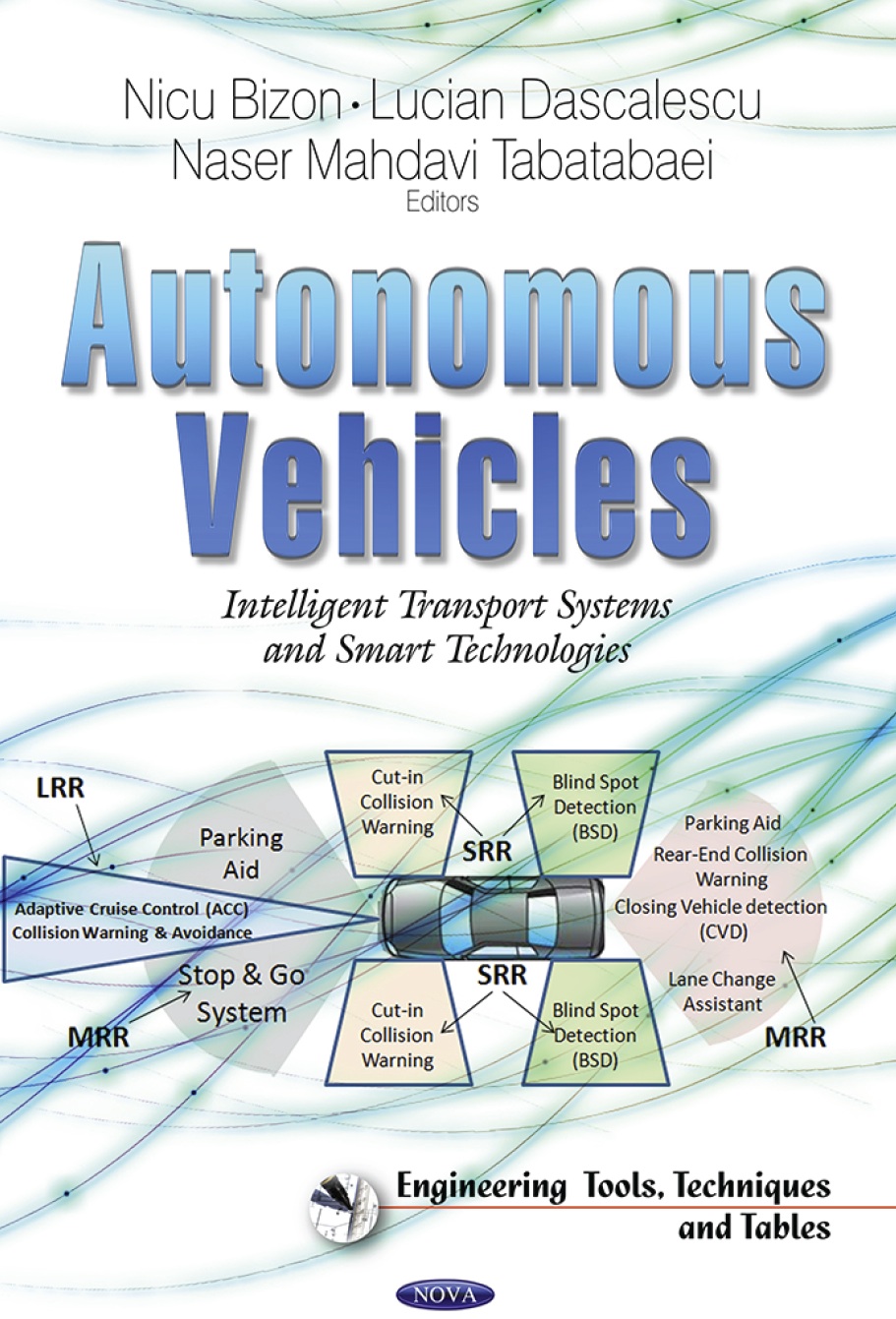
Details
W. J. C. Melis, "The Future of Electrical Vehicles", p. 509-530, In: N. Bizon, L. Dascalescu & N. M. Tabatabaei, "Autonomous Vehicles: Intelligent Transport Systems and Smart Technologies.", Nova Science Publishers, USA, 2014, ISBN: 978-1-63321-324-1.
Table of Content
To limit the length of this Table of Content, it mentions chapter titles only.
Chapter 1. Radar Sensor Detectors for Vehicle Safety Systems (Modar Safir Shbat and Vyacheslav Tuzlukov, School of Electronics Engineering, College of IT Engineering, Kyungpook National University, Korea) Chapter 2. Airborne Ultrasonic Imaging: SONAR Based Image Generation for Autonomous Vehicles (Dorel Aiordachioaie, Laurentiu Frangu, Silviu Epure, Radu Belea, Marius Mazarel, Constantin Miholca and Claudiu Chiculita, “Dunarea de Jos” University of Galati, Electronics and Telecommunications Department, Romania) Chapter 3. Autonomous Underwater Vehicle Dynamics (Mustafa Dinc and Chingiz Hajiyev, Aeronautics and Astronautics Faculty, Istanbul Technical University, Turkey) Chapter 4. Advances in Environment Sensing and Perception Technologies and Algorithms for Autonomous Ground Vehicles (Constantin Ilas, Irina Mocanu and Mariana Ilas, Department of Computer Science, University Politehnica of Bucharest, Bucharest, and Department of Electronics, Telecommunications and IT, University Politehnica of Bucharest, Bucharest, Romania) Chapter 5. Intelligent Highway Surveillance and Safety Systems (Valentin Alexandru Stan, Radu Serban Timnea and Razvan Andrei Gheorghiu, "Politehnica” University of Bucharest, Bucharest, Romania) Chapter 6. Cyber Security Evaluation of Critical Infrastructures Systems (Alecsandru Patrascu and Emil Simion, Advanced Technologies Institute, Bucharest, Romania) Chapter 7. Sustainable Information Systems Management for Spatial Governance (Angela Ionita, Marcel Foca and Maria Visan, Research Institute for Artificial Intelligence, “Mihai Draganescu” of Romanian Academy, Romania) Chapter 8. Standards of Communications in the Intelligent Transport Systems (ITS) (Maaruf Ali, Ministry of Higher Education, University of Ha'il, College of Computer Science & Engineering, Department of Computer Science & Software Engineering, Ha'il, Kingdom of Saudi Arabia) Chapter 9. Power Electronics and Drives Used in Automotive Applications (Ersan Kabalci, Electrical and Electronics Engineering Dept., Faculty of Engineering and Architecture, Nevsehir University, Turkey) Chapter 10. Power Control of Plug-In Electric Vehicles in Smart Grids (Amin Hajizadeh, Amir Hossein Shahirinia and David C. Yu, Department of Electrical Engineering, Shahrood University of Technology, Shahrood, Iran and others) Chapter 11. Optimal Short-Term Scheduling of Aggregators for Plug-In Electric Vehicles (Mohammad Moradi-Dalvand and Behnam Mohammadi-Ivatloo, Department of Electrical Engineering, Power and Water University of Technology, Tehran, and Faculty of Electrical and Computer Engineering, University of Tabriz, Tabriz, Iran) Chapter 12. Energy Efficiency of the Hybrid Power Source Used in the Plug-In Fuel Cell Vehicles (Nicu Bizon, Marian Raducu, Mihai Oproescu and Luminita Mirela Constantinescu, University of Pitesti, Arges, Pitesti, and University Politehnica of Bucharest, Bucharest, Romania) Chapter 13. Dynamic Response of Electric Machines for Electric Vehicles/Hybrid Electric Vehicles (EV/HEV) (Robert Beloiu, Mariana Iorgulescu and Corina Savulescu, University of Pitesti, Romania) Chapter 14. Use of the External Magnetic Field for Supervision and Diagnosis of Electrical Traction Motors (Remus Pusca, Raphael Romary and Andrian Ceban, University of Lille Nord de France, Lille, and University of Artois, LSEE, Béthune, France) Chapter 15. Batteries for Electrical Vehicles: A Review (Bogdan Enache, Emilian Lefter and Costin Cepisca, University of Pitesti, Faculty of Electronics, Communications and Computers, str. Targul din Vale nr. 1, Pitesti, Arges, and University Politehnica Bucharest, Faculty of Electrical Engineering, Bucuresti, Romania) Chapter 16. Computational Study of Li-Ion Batteries for Automotive Applications (Inigo Aramendia, Unai Fernandez-Gamiz, Jose Antonio Ramos, Javier Sancho and Ekaitz Zulueta, University of the Basque Country, Nuclear Engineering and Fluid Mechanics Dep. Nieves Cano 12, 01006 Vitoria-Gasteiz, Araba, Spain) Chapter 17. Ni-Cd Batteries for Automotive Applications: The ac Electrical Data of the Ni-Cd Battery in the Havriliak-Negami Dielectric Representation (Mohammad A. Alim, Sudip Bhattacharjee, Sanjida Khanam, Nasiha Muna and Sabiha Runa, Departments of Electrical Engineering, Mechanical and Civil Engineering, Mathematics, Chemical and Materials Engineering, and College of Engineering, Alabama A & M University
Huntsville, Alabama, US) Chapter 18. Advanced Drive Architectures and State of the Art In-Wheel Motors (Blaz Stefe and Gorazd Lampic, Elaphe Propulsion Technologies Ltd., Slovenia) Chapter 19. The Future of Electrical Vehicles (Wim J.C. Melis, University of Greenwich at Medway, UK)
Chapter Abstract
Electrical Vehicles (EV) entered the transportation market much earlier than their combustion engine driven counterparts. After a long period of no development, currently they have found their way back into use, but then mainly as small goods vehicles on large estates where they then often carry a label in the sense of “Zero Carbon Vehicle”. Due to the increasing social pressure for environmentally friendly transportation, their zero emissions comes to their benefit also for mainstream goods and person transport. However, there are still a few problems to be resolved to smoothen the path for a better market penetration. Even though the electrical motor has a much higher efficiency, in comparison to fossil fuel powered vehicles, overall, electrical vehicles suffer from a limited range due to the lower energy density for electrical storage. Current hybrid vehicles provide a solution to this problem by using an internal combustion engine used as a range extender. The environmental impact of this range extending motor as well as the actual electricity production itself both have an environmental impact unless green electricity is being used as an energy source and used to charge the plug-in hybrid. The environmental impact depends on the source-fuel being used, but in essence highlights the importance of finding more environmentally friendly energy sources. Additionally, it is essential to improve the overall efficiency of our transport vehicles and any energy conversions that take place during transport, by for example recovering the kinetic energy of the vehicle when it is being decelerated. As much as there has been a move towards electrical vehicles, there has been a move towards more Information and Communication Technology (ICT) within vehicles for a variety of reasons, moving towards electrical vehicles the integration of ICT with the actual vehicle is likely to become easier and therefore more efficient allowing for vehicles to become fully autonomous.
Purchase
You can order this book online, from a varity of shops, including Amazon, but it is also available through the publisher directly. |
|
Related links:
Publisher:
|